Pterosaurs
Still Living
The oldest living-pterosaur web site
Pterosaurs Still Living is here to document, then analyze, eyewitness accounts of apparent extant pterosaurs, or flying creatures that appear
to be “pterodactyls,” and to support expeditions and research to obtain relevant evidence. Please report any sighting to Jonathan Whitcomb


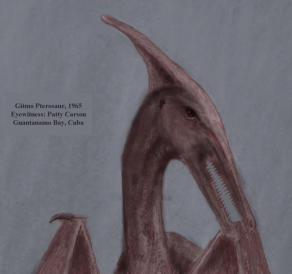
A “Gitmo pterosaurs” scared two children in Cuba in 1965

Opai villager was astonished, one night, by a bright light over a reef
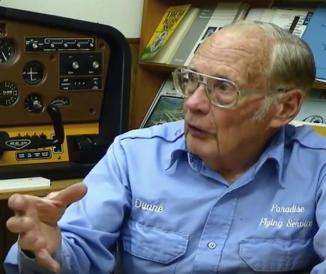
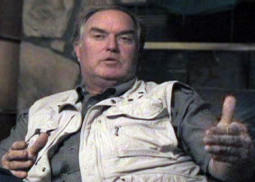
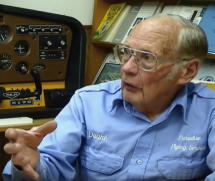
Duane Hodgkinson and his army buddy saw the “pterodactyl”
in a jungle clearing in New Guinea. The tail: 10-15 feet long.

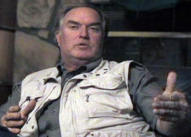
Brian Hennessy, from Australia, saw a flying creature
that “certainly looked prehistoric,” for it had a long tail,
a disproportionately-large head, and no sign of any
feathers. He’s not crazy, just another eyewitness.
Oh yes, and Mr. Hennessy is also a psychologist.
Throughout human history, and more recently, come
fascinating reports of what may have been living
pterosaurs. From “fiery flying serpents” of the Bible
ages ago, to strange flying creatures called “dragons”
in England and other European countries a few cen-
turies ago, to a huge pterosaur flying across a country
highway in South Carolina in 1986, descriptions of
these “flying dinosaurs,” commonly called by some
people “pterodactyls,” make it obvious that they are
non-fictional and very much non-extinct.
Twentieth century and twenty-first century eyewitness
testimonies in Papua New Guinea suggest that long-
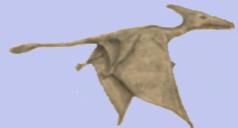
tailed Rhamphorhynchoid pterosaurs fly overhead at
night. Consider many accounts of amazing encounters
with creatures described like living pterosaurs, unlike
any bat or bird known to science.
Some reports are from Americans and Australians,
including Duane Hodgkinson (a flight instructor and
World War II veteran) and Brian Hennessy, who is a
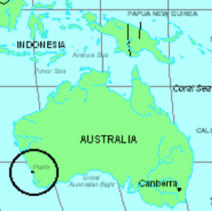
psychologist. In Perth, Australia, a couple witnessed
an extremely large featherless flying creature, yet the
sighting reports come from around the world.
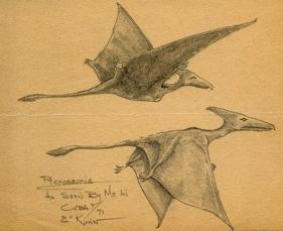
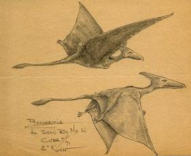
The U.S. Marine Eskin Kuhn was stationed
at the Guantanamo Bay military base in
Cuba, in 1971. One day, he saw an amazing
sight. In clear view and at close range, he
saw two pterosaurs flying together at low
elevation. He tried to get another eyewitness
to verify that two “pterodactyls” were there,
but the creatures had flown off before Kuhn
was able to pull the sergeant out the door.
Within minutes, Kuhn began sketching the
two animals. He now gives his testimony to
the world: two wonderful flying creatures.

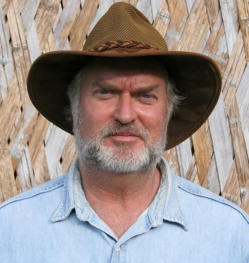
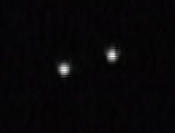
Late in 2006, American explorer Paul Nation
explained to Jonathan Whitcomb how he had
witnessed and then videotaped flying lights
deep in the mainland of Papua New Guinea.
Whitcomb took a copy of the video footage to
a missile defense physicist, Clifford Paiva,
who analyzed it. Paiva declared that common-
place explanations couldn’t explain the lights.
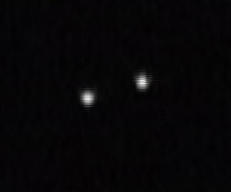
Still image from about 15 seconds of
video recorded by Paul Nation, during
his expedition deep in the mainland
interior of Papua New Guinea (2006).
A scientist later analyzed the footage,
finding the lights were not from car
headlights, flashlights, meteors, air-
plane lights, fires, etc.
Much of the research done from about 1994 till
2005 involved the ropen of Papua New Guinea:
At least six Americans participated, beginning
in the 1990’s with Carl Baugh of Texas, followed
by Paul Nation (also of Texas) and, in 2004, by
Jonathan Whitcomb, Garth Guessman, and
David Woetzel. James Blume, for many years
a Baptist missionary in Papua New Guinea, has
often assisted investigators. Although these six
Americans had few sightings, from 1994 through
2005, they interviewed native eyewitnesses.
Paul Nation’s expedition, in the Tawa Village
area of Papua New Guinea in 2006, elevated
the credibility of living-pterosaur investigations
in cryptozoology. He videotaped what he and
his associates believe was the bioluminescent
glow of two living pterosaurs. Within only a few
weeks, the TV show “Destination Truth” team
also videotaped a similar light to the east of the
village of Tawa, as it flew over the coast.
copyright 2005-2018 Jonathan Whitcomb

From 2005 until the present, eyewitness
reports in the United States have rivaled
those in Papua New Guinea. As some
Americans learned about the surprising
living-pterosaur investigations in the
southwest Pacific, eyewitnesses of many
similar flying creatures have reported
encounters to Jonathan Whitcomb. He
analyzed the many accounts and then
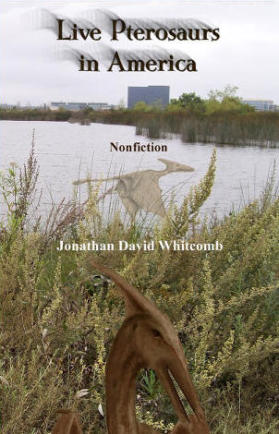
wrote the nonfiction book Live Pterosaurs
in America (expanded third edition,
published late in 2011). This astonishing
cryptozoology book is sold online by
sellers like Amazon and Barnes & Noble.
One reader of the second edition of this
book has said, “This is an updated review
of the book and I am changing my rating
to 5 stars. This book has been on my shelf
for almost a year now. I pick it up every
now and then and a part of me becomes
more impressed by the book every time.”
A reader of the first edition said, “This
seems to be the author's second book on
the subject, and this one is worth the
effort. He has focused on the accounts of
witnesses who saw something, and that
adds credibility. The writing is easy to read
and he adds comments and analysis to
make it all more useful. Mostly, the author
lets the sightings speak for themselves,
which is good. . . .”

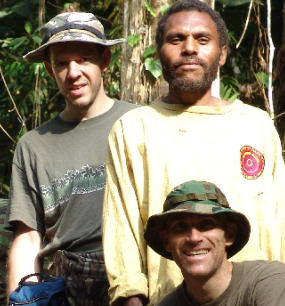
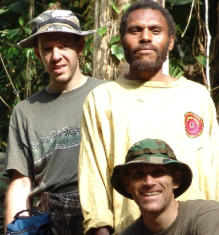
Second ropen expedition of 2004

First Umboi Island expedition of 2004
Jonathan Whitcomb, in 2004, interviewed many native
eyewitnesses of the large nocturnal ropen that flies over
this tropical island in Papua New Guinea.
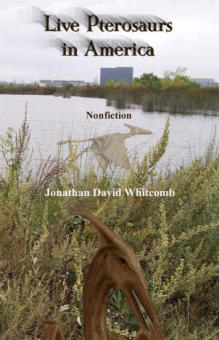
Live Pterosaurs in America (3rd ed)
Ropen sighting in eastern Cuba
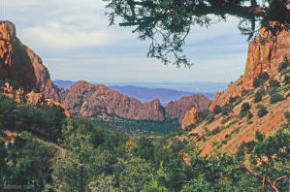
Big Bend National Park, Texas
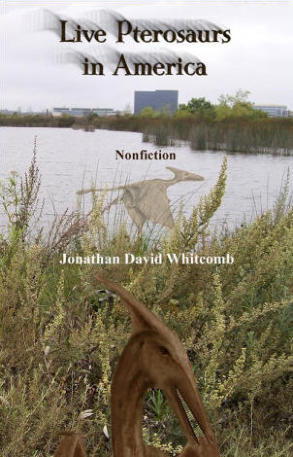
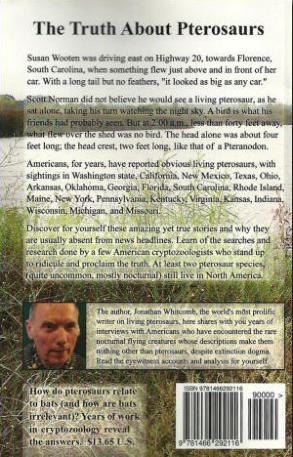
Cryptozoology book - nonfiction
Live Pterosaurs in America, third edition, by
cryptozoologist Jonathan David Whitcomb, is
sold online on Amazon, Barnes & Noble, Books-
a-Million, AbeBooks, and elsewhere
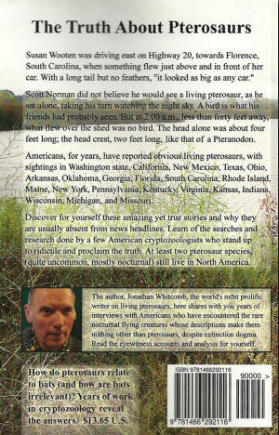
The third edition of the true-encounters book
is sold on Amazon.com and on other online sites:
Suggest retail price, $13.65
ISBN-10: 1466292113
ISBN-13: 978-1466292116
Susan Wooten was driving between the
city of Columbia, South Carolina, and the
town of Greenville, around 1986, at about
3:00 p.m., when a huge creature glided
down from the trees on the side of the high-
way and above and in front of her car. She
could see that it had no feathers. Other
drivers pulled over to the side of the high-
way that day, but Wooten could not stop
and talk with them about the amazing big
flying creature, for she was following a girl
who was driving ahead (a friend from the
college they attended), and she wanted to
keep up with her, to avoid being separated.
She did research at a library and found a
number of possibly-related reports.
Big Bend National Park
With about 800,000 acres, the Big Bend
National Park has plenty of room to hide a
nocturnal flying creature that would rarely
leave a track. The Marfa Lights that appear
north of the park—those lights fly in strange
light-splittings and in light-rejoinings, but
only a few times each year. Those glowing
flying predators (maybe they're like the
ropen) may hunt periodically in various
areas in this part of North America, not just
around Marfa. Reports of large apparent
pterosaurs flying around are not restricted
to southwest Texas. In Mexico, in areas
bordering this part of Texas, eyewitnesses
have reported frightening flying creatures
that may be related to the Marfa Lights.
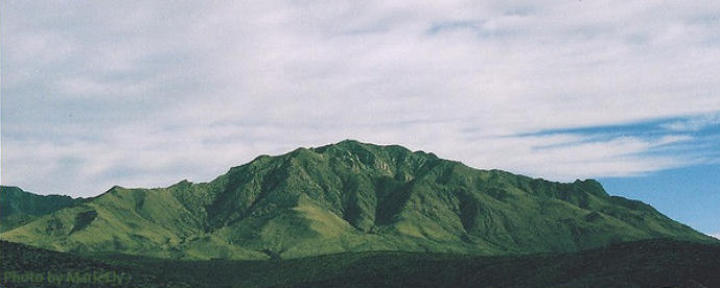
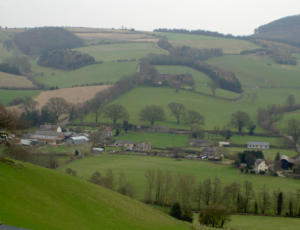
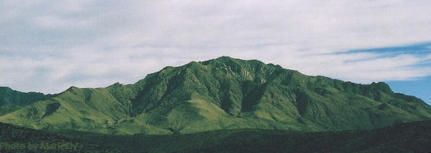
Mountains near Marfa, Texas
Not all mystery lights in southwest Texas are from car headlights. Some are called CE-III lights by the scientist
James Bunnell, who for many years has studied these phenomena around the town of Marfa, Texas. Consider it.
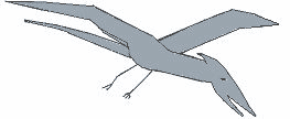
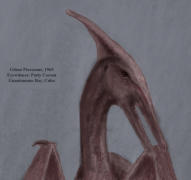
Another Eyewitness of the Gitmo Pterosaur of Cuba
The U. S. Marine Eskin Kuhn wasn't the only person to have seen a giant flying pterosaur at Guantanamo Bay,
Cuba, in the middle of the twentieth century. Patty Carson described what she had seen:
"We were walking down near the boat yards, headed home . . . We were walking through that scrub area, and
suddenly it sat up, as if it had been eating something or resting. The head and upper part of its body, about a
third of the wings at the joint . . . showed. . . . [It was] about thirty feet away . . . It did have a tail and it had a
diamond shaped tip . . . The skin was a leathery, brownish reddish color. It had little teeth, a LOT of them."
In her interview with Jonathan Whitcomb, many years later, she said nothing about any glow, for the sighting
was in daylight. These featherless nocturnal flying creatures come out in daylight only on limited occasions,
which is part of why they have not, as of mid-2017, been officially classified as extant animals by Western
science. Yet sometimes an eyewitness will be fortunate enough to see both the shape of a pterosaur and the
glow, giving us evidence that at least some of these flying creatures use bioluminescence.
Could the long-tailed pterosaur of Cuba be related to Marfa Lights in Texas and to winged creatures that
frighten people in Mexico, some of them just across the border from that area of Texas? Some eyewitnesses
have seen glowing “pterodactyls” in North America, including in the United States.
This deserves a serious investigation. As of early 2017, three scientific papers on living pterosaurs have been
written, two of them by the three scientists Clifford Paiva, Jonathan Whitcomb, and Harold Slusher.

“Diamond” shape at the end of a long tail
In his limited English, the eyewitness Wesley
Koro told the American that the tail was “long.”
When asked what they did on seeing the ropen,
Wesley said, “We run home.” Wesley’s brother
Gideon was with him at the time, as well as
their friend Mesa Augustin.


To Mesa Augustin, of a remote village on Umboi
Island, Papua New Guinea, it was terrifying,
pterosaur or not. The natives here have only
one word for it: "ropen." Yet other islanders
have other names for giant nocturnal flying
creatures that glow brightly at night.
Gideon answered many questions
It was around December of 1993 when the seven
“boys” (probably in their early teens) climbed up
to Lake Pung. Soon after they had arrived, the
ropen flew down to just above the surface of the
crater lake. The boys ran home in terror. The
American forensic videographer Jonathan David
Whitcomb interviewed three of them in 2004.
Paul Nation, from Texas
This American has been on at least four
expeditions in Papua New Guinea, more
than any other American explorer who
has searched for living pterosaurs in the
southwest Pacific. He was the first one
to bring back video footage of the glow
of the flying creatures (late in 2006).
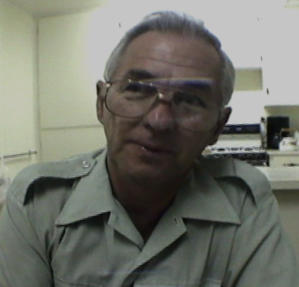
Baptist missionary Jim Blume in PNG
James Blume has been a missionary in Papua
New Guinea for over thirty years. He has assisted
a number of American Christian cryptozoologists
a number of times in the ropen investigations:
reports of apparent living pterosaurs.
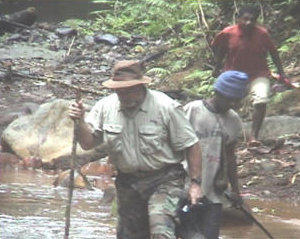
Paul Nation led the Papua New Guinea
expedition of 2002: ropen searching
With his son Nathanael Nation, Paul took a ship
from the mainland, arriving on Umboi Island,
where they interviewed natives and searched
for the elusive nocturnal ropen. Paul had been
on this island before, with Carl Baugh.
Other names and expressions used by many
eyewitnesses of apparent pterosaurs include
"pterodactyl," "flying dinosaur," "prehistoric bird,"
"flying creature," "big bird," and "dinosaur bird."
Most of the labels are technically incorrect;
scientifically correct is the word "pterosaur."
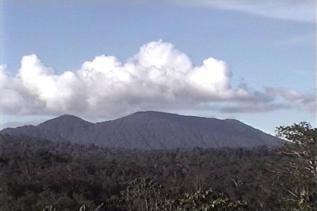
Mount Sual (photo by J. D. Whitcomb)
During the first ropen expedition of 2004, Jonathan
Whitcomb and his native interpreter Luke Paina
stayed in the home of Mark and Delilah Kau, where
they prepared for two excursions into the jungle of
Umboi Island. The second trek resulted in many
valuable interviews with native eyewitnesses.
Southwest Pacific


ver-040
Pterosaurs
Still Living
The oldest living-pterosaur web site
Pterosaurs Still Living is here to document, then analyze, eyewitness accounts of apparent extant
pterosaurs, or flying creatures that appear to be “pterodactyls,” and to support expeditions and
research to obtain relevant evidence. Please report any sighting to Jonathan Whitcomb


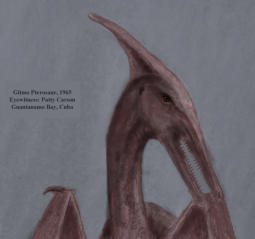
A “Gitmo pterosaurs” scared two
children in Cuba in 1965

Opai villager was astonished, one night,
by a bright light over a reef
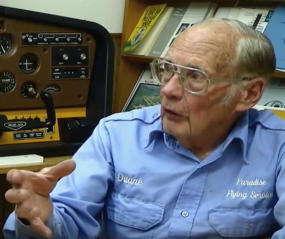
Duane Hodgkinson and his army buddy
saw the “pterodactyl” in a jungle clearing in
New Guinea. The tail was 10-15 feet long.

Brian Hennessy, from Australia, saw a flying
creature that “certainly looked prehistoric,” for
it had a long tail, a disproportionately-large
head, and no sign of any feathers. He’s not
crazy, just another eyewitness. Oh yes,
and Mr. Hennessy is also a psychologist.
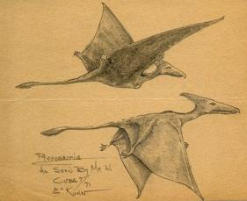
The U.S. Marine Eskin Kuhn was stationed
at the Guantanamo Bay military base in
Cuba, in 1971. One day, he saw an amazing
sight. In clear view and at close range, he
saw two pterosaurs flying together at low
elevation. He tried to get another eyewitness
to verify that two “pterodactyls” were there,
but the creatures had flown off before Kuhn
was able to pull the sergeant out the door.
Within minutes, Kuhn began sketching the
two animals. He now gives his testimony to
the world: two wonderful flying creatures.
Throughout human history, and more
recently, come fascinating reports of what
may have been living pterosaurs. From
“fiery flying serpents” of the Bible ages
ago, to strange flying creatures called
“dragons” in England and other European
countries a few centuries ago, to a huge
pterosaur flying across a country highway
in South Carolina in 1986, descriptions of
these “flying dinosaurs,” commonly called
by some people “pterodactyls,” make it
obvious that they are non-fictional and
very much non-extinct.
Twentieth century and twenty-first cen-
tury eyewitness testimonies in Papua
New Guinea suggest that long-tailed
Rhamphorhynchoid pterosaurs fly over-
head at night. Consider many accounts
of amazing encounters with creatures
described like living pterosaurs, unlike
any bat or bird known to science.
Some reports are from Americans and
Australians, including Duane Hodgkinson
(a flight instructor and World War II
veteran) and Brian Hennessy, who is a
psychologist. In Perth, Australia, a couple
witnessed an extremely large featherless
flying creature, yet the sighting reports
come from around the world.
Late in 2006, American explorer Paul Nation
explained to Jonathan Whitcomb how he had
witnessed and then videotaped flying lights
deep in the mainland of Papua New Guinea.
Whitcomb took a copy of the video footage to
a missile defense physicist, Clifford Paiva,
who analyzed it. Paiva declared that common-
place explanations couldn’t explain the lights.
Still image from about 15 seconds of
video recorded by Paul Nation, during
his expedition deep in the mainland
interior of Papua New Guinea (2006).
A scientist later analyzed the footage,
finding the lights were not from car
headlights, flashlights, meteors, air-
plane lights, fires, etc.

First Umboi Island expedition of 2004
Jonathan Whitcomb, in 2004, interviewed many
native eyewitnesses of the nocturnal ropen that
flies over this tropical island in Papua New Guinea.
Much of the research done from about 1994 till
2005 involved the ropen of Papua New Guinea:
At least six Americans participated, beginning
in the 1990’s with Carl Baugh of Texas, followed
by Paul Nation (also of Texas) and, in 2004, by
Jonathan Whitcomb, Garth Guessman, and
David Woetzel. James Blume, for many years
a Baptist missionary in Papua New Guinea, has
often assisted investigators. Although these six
Americans had few sightings, from 1994 through
2005, they interviewed native eyewitnesses.
Paul Nation’s expedition, in the Tawa Village
area of Papua New Guinea in 2006, elevated
the credibility of living-pterosaur investigations
in cryptozoology. He videotaped what he and
his associates believe was the bioluminescent
glow of two living pterosaurs. Within only a few
weeks, the TV show “Destination Truth” team
also videotaped a similar light to the east of the
village of Tawa, as it flew over the coast.
Second ropen expedition of 2004
From 2005 until the present, eyewitness
reports in the United States have rivaled
those in Papua New Guinea. As some
Americans learned about the surprising
living-pterosaur investigations in the
southwest Pacific, eyewitnesses of many
similar flying creatures have reported
encounters to Jonathan Whitcomb. He
analyzed the many accounts and then
wrote the nonfiction book Live Pterosaurs
in America (expanded third edition,
published late in 2011). This astonishing
cryptozoology book is sold online by
sellers like Amazon and Barnes & Noble.
One reader of the second edition of this
book has said, “This is an updated review
of the book and I am changing my rating
to 5 stars. This book has been on my shelf
for almost a year now. I pick it up every
now and then and a part of me becomes
more impressed by the book every time.”
A reader of the first edition said, “This
seems to be the author's second book on
the subject, and this one is worth the
effort. He has focused on the accounts of
witnesses who saw something, and that
adds credibility. The writing is easy to read
and he adds comments and analysis to
make it all more useful. Mostly, the author
lets the sightings speak for themselves,
which is good. . . .”
Live Pterosaurs in America (3rd ed)
Cryptozoology book - nonfiction
Live Pterosaurs in America, third edition, by
cryptozoologist Jonathan David Whitcomb,
is sold online on Amazon, Barnes & Noble,
Books-a-Million, AbeBooks, and elsewhere

copyright 2005-2018 Jonathan Whitcomb
The third edition of the true-encounters book
is sold on Amazon.com and on other online
sites:
Suggest retail price, $13.65
ISBN-10: 1466292113
ISBN-13: 978-1466292116
Susan Wooten was driving between the
city of Columbia, South Carolina, and the
town of Greenville, around 1986, at about
3:00 p.m., when a huge creature glided
down from the trees on the side of the high-
way and above and in front of her car. She
could see that it had no feathers. Other
drivers pulled over to the side of the high-
way that day, but Wooten could not stop
and talk with them about the amazing big
flying creature, for she was following a girl
who was driving ahead (a friend from the
college they attended), and she wanted to
keep up with her, to avoid being separated.
She did research at a library and found a
number of possibly-related reports.
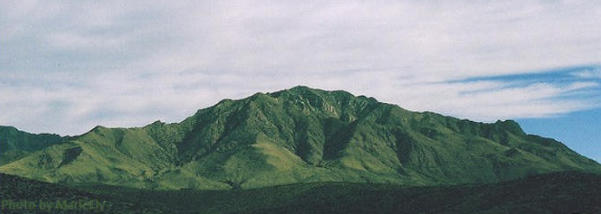
Mountains near Marfa, Texas
Not all mystery lights in southwest Texas are from car headlights. Some are called CE-III
lights by the scientist James Bunnell, who for many years has studied these phenomena
around the town of Marfa, Texas. Consider it.
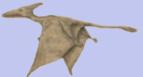

“Diamond” shape at the end of a long tail
In his limited English, the eyewitness Wesley
Koro told the American that the tail was “long.”
When asked what they did on seeing the ropen,
Wesley said, “We run home.” Wesley’s brother
Gideon was with him at the time, as well as
their friend Mesa Augustin.

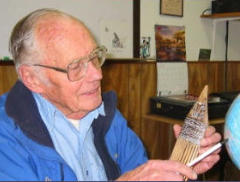
To Mesa Augustin, of a remote village on Umboi
Island, Papua New Guinea, it was terrifying,
pterosaur or not. The natives here have only
one word for it: "ropen." Yet other islanders
have other names for giant nocturnal flying
creatures that glow brightly at night.

Gideon answered many questions
It was around December of 1993 when the
seven “boys” (probably in their early teens)
climbed up to Lake Pung. Soon after they
had arrived, the ropen flew down to just
above the surface of the crater lake. The
boys ran home in terror. The forensic
videographer Jonathan David Whitcomb
interviewed three of them in 2004.

Paul Nation, from Texas
This American has been on at least
four expeditions in Papua New Guinea,
more than any other American explorer
who has searched for living pterosaurs
in the southwest Pacific. He was the
first one to bring back video footage
of the glow of the flying creatures
(late in 2006).
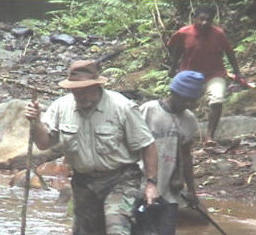
Paul Nation led the Papua New Guinea
expedition of 2002: ropen searching
With his son Nathanael Nation, Paul took a ship
from the mainland, arriving on Umboi Island,
where they interviewed natives and searched
for the elusive nocturnal ropen. Paul had been
on this island before, with Carl Baugh.
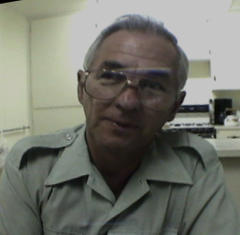
Baptist missionary Jim Blume in PNG
James Blume has been a missionary in
Papua New Guinea for over thirty years.
He has assisted a number of American
Christian cryptozoologists a number of
times in ropen investigations: reports
of apparent living pterosaurs.
Other names and expressions used by many
eyewitnesses of apparent pterosaurs include
"pterodactyl," "flying dinosaur," "prehistoric bird,"
"flying creature," "big bird," and "dinosaur bird."
Most of the labels are technically incorrect;
scientifically correct is the word "pterosaur."
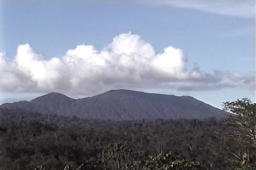
Mount Sual (photo by Whitcomb)
During the first ropen expedition of 2004,
Jonathan Whitcomb and his native inter-
preter Luke Paina stayed in the home of
Mark Kau, where they prepared for two
excursions into the jungle of Umboi Island.
The second trek resulted in many valuable
interviews with native eyewitnesses.

ver-040

Pterosaurs
Still Living

The oldest living-pterosaur web site
Pterosaurs Still Living is here to document, then analyze,
eyewitness accounts of apparent extant pterosaurs, or flying
creatures that appear to be “pterodactyls,” and to support
expeditions and research to obtain relevant evidence.
Please report any sighting to Jonathan Whitcomb
copyright 2005-2018 Jonathan Whitcomb

A “Gitmo pterosaurs” scared
two children in Cuba in 1965
Duane Hodgkinson and his army buddy
saw the “pterodactyl” in a jungle clearing
in New Guinea. Tail was ~10-15 feet long.

An Opai villager was astonished,
one night: a bright light over a reef

Brian Hennessy, from Australia, saw a
flying creature that “certainly looked
prehistoric,” for it had a long tail, a
disproportionately-large head, and
no sign of any feathers. He’s not
crazy, just another eyewitness. Oh
yes, and Mr. Brian Hennessy is
also a professional psychologist.
The U.S. Marine Eskin Kuhn was
stationed at the Guantanamo Bay
military base in Cuba, in 1971. One
day, he saw an amazing sight. In
clear view and at close range, he
saw two pterosaurs flying together
at low elevation. He tried to get
another eyewitness to verify that
two “pterodactyls” were there, but
the creatures had flown off before
Kuhn was able to pull the sergeant
out the door. Within minutes, Kuhn
began sketching the two animals. He
now gives his testimony to the world:
two wonderful flying creatures.
Throughout human history, and more
recently, come fascinating reports of
what may have been living pterosaurs.
From “fiery flying serpents” of the
Bible ages ago, to flying creatures
called “dragons” in England and other
European countries a few centuries
ago, to a huge pterosaur flying across
a country highway in South Carolina
in 1986, descriptions of these “flying
dinosaurs,” commonly called by some
people “pterodactyls,” make it
obvious that they are non-fictional
and very much non-extinct.
Twentieth century and twenty-first
century eyewitness testimonies in
Papua New Guinea suggest that long-
tailed Rhamphorhynchoid pterosaurs
fly over-head at night. Consider many
accounts of amazing encounters with
flying creatures described like living
pterosaurs, unlike any bat or bird
known to science.
Some reports are from Americans
and Australians, including Duane
Hodgkinson (a flight instructor and
World War II veteran) and Brian
Hennessy, who is a psychologist. In
Perth, Australia, a couple witnessed
an extremely large featherless
flying creature, yet the sighting
reports come from around the world.
Late in 2006, American explorer
Paul Nation explained to Jonathan
Whitcomb how he had witnessed and
then videotaped flying lights deep in
the mainland of Papua New Guinea.
Whitcomb took a copy of the video
footage to a missile defense physicist,
Clifford Paiva, who analyzed it. Paiva
declared that common-place explana-
tions couldn’t explain the lights.
Still image from about fifteen
seconds of video recorded by
Paul Nation (2006) during his
expedition deep in the main-
land interior of Papua New
Guinea. A scientist later did
an analysis of the footage,
finding the lights were not car
headlights, flashlights, meteors,
airplane lights, fires, etc.

Jonathan Whitcomb, in interviewed
many native eyewitnesses (2004) of
the nocturnal ropen that flies over this
tropical island in Papua New Guinea.
First Umboi Island expedition
of the year 2004 (Whitcomb)
Second ropen expedition of
2004 (Woetzel-Guessman)
Much of the research done from
about 1994 till 2005 involved the
ropen of Papua New Guinea: At
least six Americans participated,
beginning in the 1990’s with Carl
Baugh of Texas, followed by Paul
Nation (also of Texas) and, in
2004, by Jonathan Whitcomb,
Garth Guessman, and David
Woetzel. James Blume, for many
years a Baptist missionary in
Papua New Guinea, has often
assisted investigators. Although
these six Americans had few
sightings, from 1994 through
2005, they interviewed native
eyewitnesses.
Paul Nation’s expedition, in the
Tawa Village area of Papua New
Guinea in 2006, elevated the
credibility of living-pterosaur
investigations in cryptozoology.
He videotaped what he and
his associates believe was the
bioluminescent glow of two living
pterosaurs. Within only a few
weeks, the TV show “Destination
Truth” team also videotaped a
similar light to the east of the
village of Tawa, as it flew over
the coast.
Cryptozoology book -
nonfiction
Live Pterosaurs in America, 3rd ed.,
by cryptozoologist Jonathan David
Whitcomb, is sold online on Amazon,
Barnes & Noble, Books-a-Million,
AbeBooks, and elsewhere
Susan Wooten was driving bet-
ween the city of Columbia, South
Carolina, and Greenville, around
1986, at about 3:00 p.m., when
a huge creature glided down from
the trees on the side of the high-
way and above and in front of her
car. She could see that it had no
feathers. Other drivers pulled
over to the side of the highway
that day, but Wooten could not
stop and talk with them about
the amazing big flying creature,
for she was following a girl who
was driving ahead (a friend from
the college they attended), and
she wanted to keep up with her,
to avoid being separated. She
did research at a library and
found a number of possibly-
related reports.

Mountains near Marfa, Texas
Not all mystery lights in southwest Texas are from car headlights.
Some are called CE-III lights by the scientist James Bunnell, who for
many years has studied these phenomena around the town of Marfa,
Texas. Consider the details and how they might relate to ropens.

“Diamond” shape at the end of
a long tail (ropen sighting)
In his limited English, the eyewitness
Wesley Koro told the American that
the tail was “long.” When asked what
they did on seeing the ropen, Wesley
said, “We run home.” Wesley’s brother
Gideon was with him at the time, as
well as their friend Mesa Augustin.

To Mesa Augustin, of a remote village
on Umboi Island, Papua New Guinea,
it was terrifying, pterosaur or not. The
natives here have only one word for
it: "ropen." Yet other islanders have
other names for giant nocturnal flying
creatures that glow brightly at night.

Gideon answered many questions
It was around December of 1993 when
the seven “boys” (probably in their early
teens) climbed up to Lake Pung. Soon
after they had arrived, the ropen flew
down to just above the surface of the
crater lake. The boys ran home in terror.
The forensic videographer Jonathan
David Whitcomb interviewed three of
the seven eyewitnesses in 2004.

Paul Nation, from Texas
This American has been on at least
four expeditions in Papua New
Guinea, more than other American
explorers who have searched for
living pterosaurs in the southwest
Pacific. He was the first one to bring
back video footage of the glow of
the flying creatures (late in 2006).
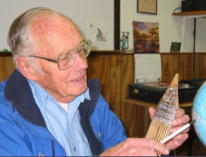
Other names and expressions used by
eyewitnesses of apparent pterosaurs
include "pterodactyl," "flying dinosaur,"
"prehistoric bird," "flying creature," "big
bird," and "dinosaur bird." Most of the
labels are technically incorrect; on the
other hand, the scientifically correct
word is "pterosaur."
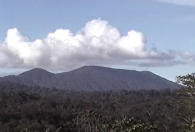
Mt. Sual (photo by Whitcomb)
During the first ropen expedition
of 2004, Jonathan Whitcomb
and his native interpreter Luke
Paina stayed in the home of
Mark and Delilah Kau, where
they prepared for two excursions
into the jungle of Umboi Island.
The second trek resulted in
many valuable interviews with
native eyewitnesses.

ver-040